
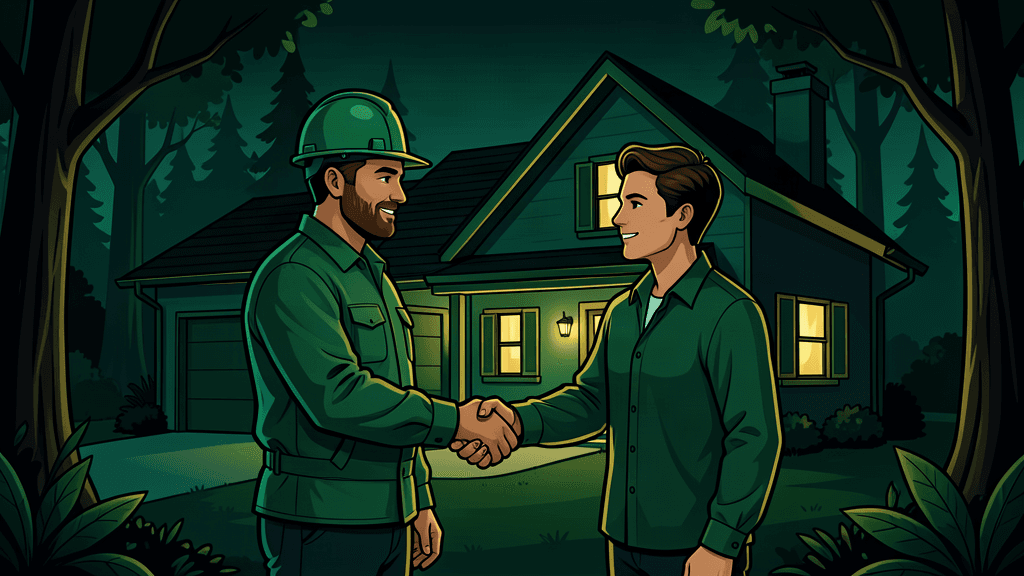
Two contractors. Same neighborhood. Same trucks. Same prices, give or take a hundred bucks. One books out three weeks solid. The other is refreshing his phone at 4 PM wondering if the season is finally catching up to him.
What is the difference? It is not the equipment. It is not the years in business. It is not even the price. It is whether the homeowner trusts one of them enough to hand over a check for four figures without lying awake about it that night.
Homeowners do not buy roofing, HVAC, plumbing, or electrical work. They buy the feeling of not getting ripped off. They buy certainty. Every time a homeowner chooses a contractor, they are running a silent risk calculation: who is least likely to take my money and disappear, do shoddy work, or surprise me with a bill that does not match the quote?
Your job as a contractor is not to be the cheapest. It is to be the safest bet in the customer's mind. That is what we call the trust stack. Stack enough trust signals in the right order and price stops being the deciding factor. Here is how to build it, one layer at a time.
Why Homeowners Default to Price (And Why That Is Your Fault)
When a homeowner goes with the lowest bid, it is almost never because they are cheap. It is because every contractor looked the same. Same vague quote. Same "we will get to it when we get to it." Same unknown guy in an unmarked truck who might be great or might be a nightmare.
When you cannot tell the difference between options, you pick the cheapest one, because if they all feel equally risky, why pay more? Price becomes the tiebreaker the moment trust becomes a coin flip.
The contractor who loses on price is almost always the contractor who never gave the homeowner a reason to believe he was different. He showed up, measured, muttered a number, and left. He made himself a commodity. Commodities get compared on price. Trusted experts get compared on who the homeowner likes and believes.
So stop blaming the cheap guy across town. He is not beating you. You are handing him the win by making yourself indistinguishable.
Layer One: Be Findable and Look Legit Before the First Phone Call
Trust starts before the homeowner ever talks to you. It starts in the ten seconds they spend scanning your Google Business Profile, your website, and your reviews.
Ask yourself what a stranger sees in that ten seconds. Do they see professional photos of real completed jobs, or a blurry picture of a truck taken at dusk? Do they see fifty recent reviews with the owner responding to each one, or three reviews from 2019? Do they see a phone number and a contact form right at the top, or do they have to hunt for it?
Every one of these details is a trust signal or a trust leak. A homeowner scanning three contractors side by side is quietly scoring them. Clean, complete, active profiles beat half-filled ones every time, even when the half-filled one is a better contractor.
The fix is boring and it works. Get real photos of your crews and finished jobs on your profile. Collect reviews relentlessly, right after every job, while the relief is still fresh. Respond to every review, the five stars and the one stars. Keep your hours accurate. Post updates so the profile looks alive.
You are not doing this for search rankings alone. You are doing it so the homeowner arrives at your first conversation already half-convinced. That is a massive head start before you have said a word.
Layer Two: Win the First Response Before You Win the Bid
Speed decides more jobs than most contractors will ever admit. The first contractor to respond to an inquiry is dramatically more likely to win it, not because they are the best, but because they got there while the homeowner was still in the market and still shopping.
When a lead sits for six hours, three things happen. The homeowner cools off. Another contractor calls first and starts building rapport. The whole job slides toward whoever showed up. A slow response says one thing loud and clear: "Your problem is not urgent to us."
Build a system so no lead touches a voicemail void. Missed calls should trigger an automatic text back within a minute. Web form submissions should fire an alert to a real phone. Someone should own every inbound lead, by name, with a response time they are accountable for. If the office is dark, an after-hours answering service or automated text keeps the ball in play.
The goal is not to have the perfect script. It is to be the contractor who answered. In a market where everyone else is unreliable, simply being responsive makes you look like the professional in the room.
Layer Three: Sell the Process, Not Just the Price
Here is where most contractors fumble the money conversation. They walk in, look at the job, and hand over a number. That number is now a naked number, and naked numbers get compared to other naked numbers. Price war. You lose.
Instead, sell the process. Walk the homeowner through exactly what happens, step by step. Show them the inspection. Explain what you found and why it matters. Show them photos of what a bad version of this job looks like, so they understand the risk they are avoiding. Then present your scope clearly: what is included, what materials you use, what your warranty covers, who shows up, how long it takes, and what happens if something goes wrong.
When you sell the process, you change the comparison. The homeowner is no longer comparing your number to another number. They are comparing a clear, safe, explained job to a vague, risky, unexplained one. That is a comparison you win even at a higher price.
Give them options, not a single take-it-or-leave-it number. A good, better, best menu lets the homeowner choose how much certainty they want. It moves the conversation from yes or no to which one, and it puts the decision in their hands instead of making you the bad guy pushing a price.
Layer Four: Remove Every Risk They Are Quietly Worried About
Homeowners carry a mental list of fears about contractors. They will not always say them out loud, but they are there: the crew that never shows, the bill that grows, the damage that gets blamed on something else, the warranty that turns out not to exist.
Kill those fears in writing, before they have to ask.
Put your license and insurance numbers on the quote. Offer a written warranty and explain what it actually covers in plain English. Show a real review or two from a job just like theirs. Give them a realistic schedule and tell them what could move it. Give them one direct phone number for the person managing their job, not a call center. Confirm the price is the price, in writing, with no vague "extras."
Each of these does two jobs. It removes a fear, and it stacks another layer of trust on top of the last one. By the time you present the quote, the homeowner is not weighing you against the cheapest guy. They are deciding whether to sign today or call you back tomorrow, and that is exactly where you want them.
Layer Five: Be Impossible to Forget After the Job
The trust stack does not end when you get the check. It ends when they call you again, refer their neighbor, and leave you a review without being asked twice.
A clean job site, a courteous crew, and a final walkthrough where you point out everything you did turn a satisfied customer into a loyal one. Then follow up. A short text the next day asking how everything is working. A reminder when maintenance is due. A simple thank you with a review link while the goodwill is still warm.
Most contractors disappear the second the invoice is paid. Do not be most contractors. The contractor who stays in touch becomes the default in that neighborhood, and the default never gets compared on price. The default just gets called.
Frequently Asked Questions
Do I really have to compete on more than price?
If you want to stay profitable, yes. Price-only competition is a race to the bottom, and someone hungrier than you will always underbid you. Sell the process, the warranty, and the certainty instead, and price stops being the whole conversation. Homeowners will pay more for a contractor they trust.
What is the fastest trust signal I can add this week?
Reviews. Ask every satisfied customer for one right after the job, and respond to every review you get. A steady flow of recent, specific, positive reviews is the single cheapest and most powerful trust signal a home service business has. It works on Google, on your website, and in the homeowner's head.
My prices are higher than competitors. How do I keep winning?
By being worth it and making that obvious. Explain what your higher price buys: better materials, a real warranty, licensed crews, a schedule you keep. When your process is clearly safer and better explained than a cheap competitor's vague quote, the higher price stops looking like a problem and starts looking like the reason to pick you.
How fast do I need to respond to a new lead?
Minutes, not hours. The first contractor to respond wins a disproportionate share of jobs. Set up text-back for missed calls, instant alerts for web forms, and make one person accountable for every lead's response time. Speed is a trust signal all by itself.
Does any of this help my marketing and ads?
It multiplies everything. When your trust stack is strong, the same ad budget converts better, more leads book, and fewer tire-kickers waste your time. Marketing gets people to look at you. Trust gets them to hire you. Fix the trust and every dollar you spend on leads works harder.
Stop Racing to the Bottom
You will never out-cheap the cheapest contractor in town, and you should not try. The contractors who win long term are the ones homeowners believe and remember. They are the ones who got found first, responded fastest, sold a process instead of a price, and removed every risk the homeowner was quietly worried about.
That is the trust stack. Build it layer by layer, and price stops being the fight.
Ready to build a lead system that puts you in front of homeowners before the cheap guys even answer the phone? Talk to Stag Marketing and let us build the marketing engine that stacks the deck in your favor.